How does Should I Grade It? work?
Take the card out of its sleeve and point your phone at it. The app photographs it, reads the card number to identify it, measures centering, corners, edges and surface, then shows the likely PSA grade, its TCGplayer price raw and graded, and whether it's worth grading.
About a minute, start to finish. You just need your phone and a lamp or window.
Out of the sleeve
Plastic glare hides wear, so pull the card out of its sleeve or toploader first.
Live scan
Point your phone at the card. It takes the photo itself when it's sharp, and reads the card number and set symbol from it.
Scan
It IDs the card, estimates the grade, and pulls raw and graded comps. Add a back and tilted photo for corners, edges and surface.
Know before you grade
The PSA prices, the maths and the centering rules, one topic at a time.
How much does PSA grading cost in 2026?
PSA's cheapest tier is Value again: $39.99 a card from October 29, 2026, for cards worth up to $500. Standard is $59.99 for cards up to $1,000 and Priority $79.99 up to $1,500. With shipping and insurance, one card costs roughly $60 to $75 through Value and $80 to $95 through Standard.
PSA paused its cheaper tiers on June 2 to work through a backlog, added Standard in September, and on October 28 announced Value's return and cut the Standard and Priority turnaround estimates by 20 business days. New Value orders join the queue behind everything already at PSA. Value Bulk stays paused until the backlog, 7.2 million cards on October 20, falls to about 5 million.
| PSA tier | Per card | Max card value | Estimated turnaround |
|---|---|---|---|
| Value, back October 29 | $39.99 | $500 | 90 to 100 business days |
| Standard | $59.99 | $1,000 | 70 to 80 business days |
| Priority | $79.99 | $1,500 | 50 to 60 business days |
| Express | $199 | $2,500 | 20 to 30 business days |
| Value Bulk (Collectors Club only) | Paused |
Your card goes in the cheapest tier whose cap covers its value after grading. CGC and Beckett can be cheaper per card. Every tier, turnaround and the all-in cost are in the full cost guide. The latest PSA update is here. Tiers change fast, so check PSA's site before you ship.
Is my Pokémon card worth grading?
It's worth grading when the card's value at the grade it will likely get, minus its raw value, clearly beats the cost of grading, and still doesn't lose money one grade lower. With PSA's Value tier back, that means clearing roughly $65 per card for cards worth up to $500 graded, or $85 through Standard for cards up to $1,000, before any selling fees.
Only if the grade adds clearly more than it costs, since a slab can come back lower than you hoped. Here's the Lugia at today's PSA pricing:
| PSA 7 value | $790 |
| Raw value | − $391 |
| PSA Standard, the tier a $790 card needs, with shipping and insurance, about | − $85 |
| Gain from grading | $314 |
Worth it.
Value's return at $39.99 lowers the bar for cheaper cards by about $20 each, though new Value orders wait behind PSA's backlog. Other graders such as CGC can change the math again.
What centering does a PSA 10 need?
About 55/45 or better on the front, both left to right and top to bottom, and 75/25 or better on the back. A PSA 9 allows about 60/40 on the front. Corners, edges and surface also need to be flawless for a 10.
Centering is the first thing to check, because it's the easiest to measure and it can't be fixed. PSA's limits:
| Grade | Front | Back |
|---|---|---|
| PSA 10 | 55/45 | 75/25 |
| PSA 9 | 60/40 | 90/10 |
The app measures centering from your front photo to the percent, so you know right away whether a 10 is even possible. Check yours with the centering calculator, or read how to measure it yourself.
How to photograph Pokémon cards for an accurate scan
- One light source, like a lamp or a bright window.
- Phone straight above the card, card filling most of the screen.
- For the tilted shot, tip the card until the glare slides across it. Scratches light up; printing doesn't.
- Keep the whole card in the frame and sharp: the card is identified from the front photo itself.
What you get back
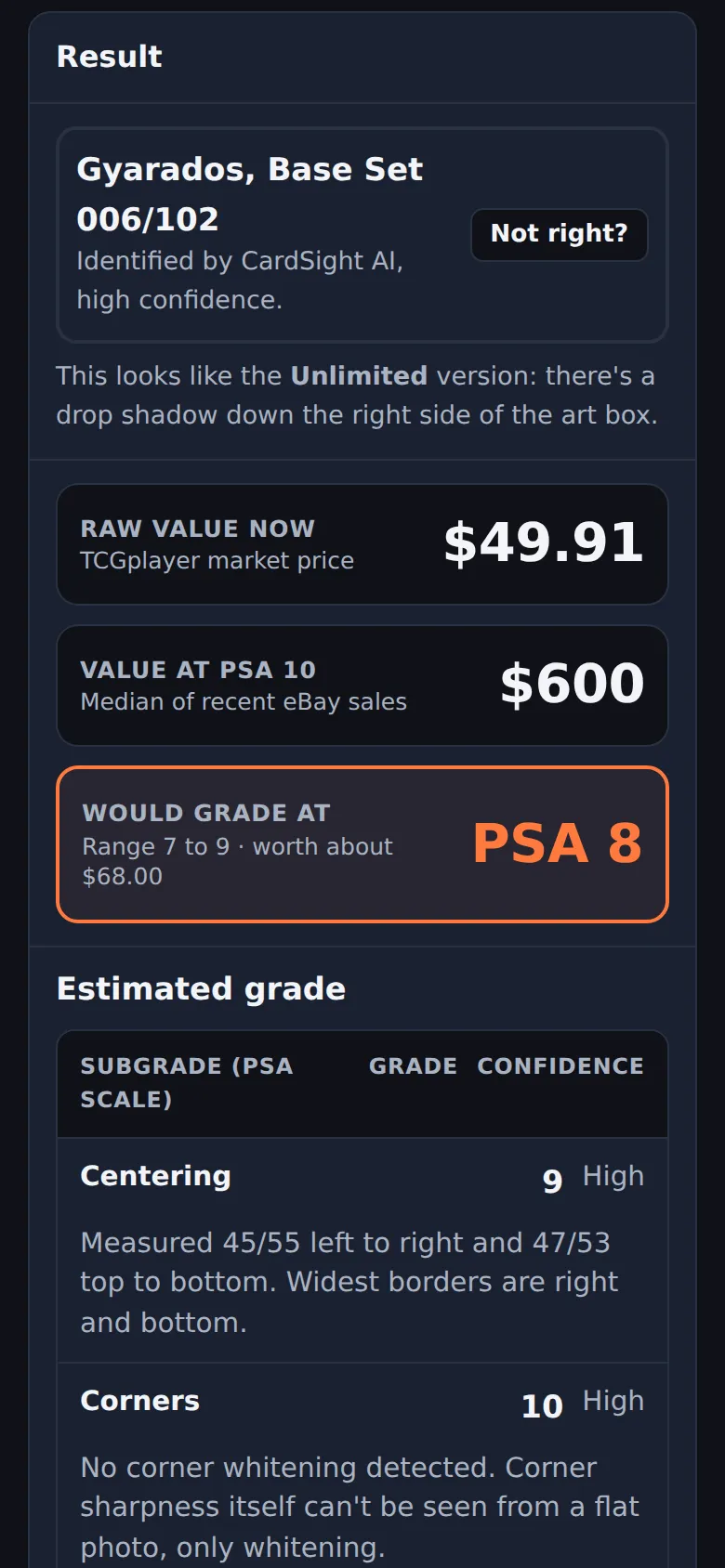
An example for a Neo Genesis Lugia. The prices are real sales from September 2026; the condition details show what a typical scan reports.

A grade, plus a range
Photos aren't perfect, so you get the likely grade and how far it could swing. PSA grades a card by its weakest point, and so does this.
The reasons behind it
Centering, corners, edges and surface, each checked on its own. Here, light surface scratches are what hold the card back from an 8.
Raw vs slabbed comps
The TCGplayer market price raw, the median eBay sale at the likely grade, and links to the card's TCGplayer listing and its latest eBay sold listings so you can check the comps yourself.
Where do the prices come from?
Raw values are TCGplayer market prices for the exact printing, refreshed daily, so Unlimited, Shadowless and 1st Edition copies are priced separately. Graded values are the median of recent eBay sales at each grade, with links to the latest sold listings so you can check them.
Every card you scan is matched to its TCGplayer listing, and the raw value shown is TCGplayer's market price, refreshed daily. Where a card was printed more than once, you see each printing's price side by side, because they can be worlds apart.
| Base Set Charizard 4/102 | TCGplayer market |
|---|---|
| Unlimited | about $410 |
| Shadowless | about $1,000 |
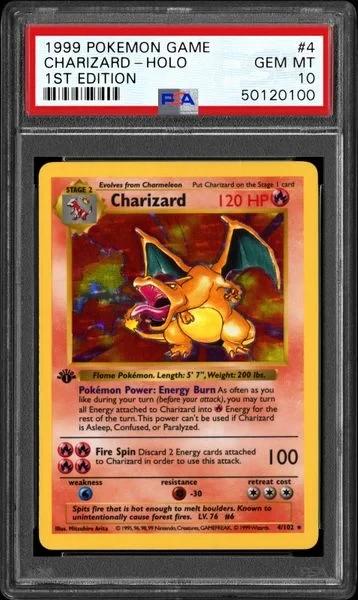
| 1st Edition | several thousand |
Prices as of early October 2026 and rounded; they move daily. The app tells you to check which printing you're holding, and links straight to the listing.
How it compares to other Pokémon card grading apps
Should I Grade It? is a Pokémon card grade checker that's free to start. It runs in a phone's web browser, estimates the PSA grade and subgrades a card would likely receive from your photos, shows the card's TCGplayer market price raw and its value at that grade from recent eBay sales, and keeps a collection you can view on your phone and computer. There is no app store download, a free account keeps the collection and its daily value history safe across devices, and the grade is measured on the phone, with the card identified by CardSight AI's recognition.
| Compared with typical AI grading apps | Should I Grade It? | Typical AI grading app |
|---|---|---|
| Price | 5 free scans a month, then unlimited for $3.99 a month, or $2.67 a month yearly, at founding member prices until January 1, 2027 | Often 2 free scans, then $4 to $10 a month for 30 to 125 scans |
| Live camera scanning | Yes, in the browser, on every plan | Often limited, in a separate app |
| Card recognition | CardSight AI, then matched to the exact TCGplayer printing | Varies |
| Collection value tracking | Every card valued daily from TCGplayer, with your total over time | Varies |
| How the grade is explained | Each measurement shown, like 57/43 centering | A score from a model |
| Grading scales | PSA estimate, plus subgrades for each part of the card | Usually PSA only |
| Prices | TCGplayer raw, eBay sales graded, per printing | Varies |
| Account | Optional and free: sign in with just your email, no password | Usually required |
"Typical" describes common patterns across current grading apps, not any one product. Details change, so check each app's own page.
Pricing
Start free. Upgrade only if you scan a lot. The calculators and your collection are free on every plan.
- 5 full scans a month
- 5 eBay sold lookups a month
- Live scan, grade estimate, values and decision
- Calculators and collection, unlimited
$2.67 a month, save 33%. Rises to $39.99 for new subscribers on January 1, 2027.
- Unlimited scans
- Unlimited eBay sold lookups
- Everything in Free
- One plan covers your phone and computer
Rises to $4.99 for new subscribers on January 1, 2027.
- Unlimited scans
- Unlimited eBay sold lookups
- Everything in Free
- Cancel anytime
Unlimited means up to 300 scans a month under fair use, far more than any collector needs. Payments are handled securely by Stripe. Terms · Privacy
Guides and free tools
Longer answers to the questions collectors ask most, kept current. All guides.
BGS Black Label 10: the holy grail
How it beats a PSA 10, and a $163,300 Black Label Mew sale.
Beckett, CGC and TAG 10s explained
BGS Pristine vs Gem Mint, and what a Black Label sells for against a PSA 10.
PSA 10 Pokémon card prices
What a 10 needs, and what 12 popular cards sell for at PSA 10, PSA 9 and raw.
PSA grading update: Value is back
The latest from PSA: Value at $39.99 from October 29, faster Standard and Priority, and the backlog.
Base Set Charizard value in 2026
Raw, PSA 6, 7 and 10 prices for Unlimited, Shadowless and 1st Edition, and where grading pays.
PSA 9 vs PSA 10: the price gap
The exact differences, why a 10 sells for two to four times a 9, and how to tell before you submit.
Shadowless vs Unlimited vs 1st Edition
The drop shadow, HP text and copyright checks, spotting a fake stamp, and the value of each.
PSA grading cost in 2026
Every tier, the return of the $39.99 Value tier, and the real all-in price per card.
Pokémon card centering explained
How to measure it from a photo, and the exact limits for a PSA 10, 9, 8 and 7.
Centering report: Pokémon sets ranked
Live data from anonymous scans: which sets are best and worst centred for a PSA 10.
PSA centering tool
Front and back centering for Pokémon and One Piece cards, from border widths or a photo, with the best PSA grade it allows.
PSA grading calculator
Your net after PSA fees, shipping and eBay fees, with the break-even price.
FAQ
Is this an official grade?
No. It's an estimate from photos, to help you pick which cards are worth submitting. Only graders like PSA, CGC and Beckett can give an official grade.
PSA or another grader, which should I use?
PSA slabs usually sell for the most, which matters for high-value cards you plan to sell. CGC and Beckett are alternatives that can cost less per card. This app estimates the PSA grade, with subgrades showing what holds each card back.
What's the cheapest way to get a card graded right now?
PSA's Value tier, back from October 29, 2026 at $39.99 per card for cards worth up to $500, with an estimated 90 to 100 business days. New Value orders queue behind everything already at PSA, so Standard at $59.99, now 70 to 80 business days, can come back sooner. CGC and Beckett can cost less per card too.
Can I just point my phone at the card?
Yes. Tap Live scan and point your camera at the card. It takes the front photo itself once the picture is sharp, then reads the card number live as you bring it into the box, and locks on once several readings agree. Free accounts get 5 full scans a month, and Pro is unlimited.
Does it work on One Piece cards?
The free tools do. The centering calculator and the grading calculator work for One Piece, Magic, sports cards or anything else with a border, by typing in the border widths or the prices. The photo scanner and the price guide are Pokémon only for now, because that's the catalog it's matched against.
Does it work on promos and newer sets?
Yes. It IDs English Pokémon cards from the collector number, including promos like SWSH283 and Trainer Gallery cards like TG14/TG30.
Where do the prices come from?
Raw is TCGplayer's market price for that exact printing, refreshed daily. Graded is the median of recent eBay sales at that grade, with links to the latest sold listings. Every result links to the card's TCGplayer page.
Is this connected to TCGplayer?
It uses TCGplayer's public catalog and market prices, so card names, numbers, printings and prices match what you'd see on TCGplayer. It isn't run by or affiliated with TCGplayer.
How much does it cost?
Every month you get 5 full scans free, and the centering calculator, grading calculator and your collection are free with no limit. Pro is $3.99 a month or $31.99 a year, which works out to $2.67 a month, and removes the scan limit. Those are founding member prices: subscribe before January 1, 2027 and you keep them for as long as you stay subscribed. After that, new subscriptions are $4.99 a month or $39.99 a year. Cancel anytime.
How is my collection saved?
On your device straight away, and with a free account, to your account too. Sign in with your email on any phone or computer and your collection comes back, with each card's value tracked daily from TCGplayer and your total collection value charted over time. No password needed: you get a 6-digit code by email.
How does it recognise the card?
The front photo is sent to CardSight AI, a card recognition service, which names the card. The app then matches it to the exact TCGplayer printing for prices. The grading measurements, centering, corners, edges and surface, are done on your phone. Add the app to your home screen and it opens like an app.
What about Beckett, CGC and TAG grades?
Beckett's 10 is Pristine and its Gem Mint is a 9.5; a Black Label is a Pristine 10 with all four subgrades at 10. CGC, TAG and SGC each have a Gem Mint 10 and a stricter Pristine 10. A Black Label can sell for several times a PSA 10, but a BGS 9.5 sells for well under one. The full comparison is here.